
History of Amarnath Cave Temple
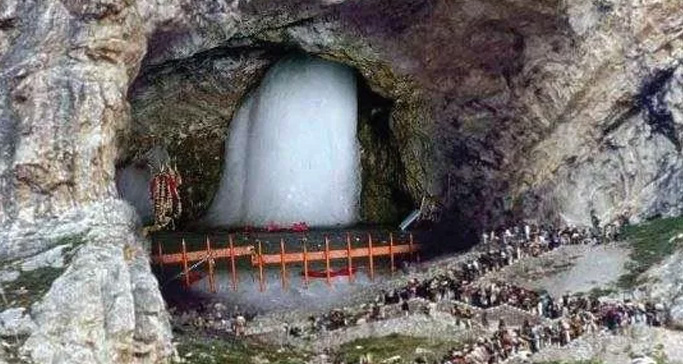
Amarnath is likely the most mainstream house a journey trip. What causes an outing to up there increasingly important is maybe the various legendary and verifiable stories joined to it. The most famous story is maybe of the Amarnath cavern. It is stated, that Parvati, the spouse of Lord Shiva, once addressed him upon the accessory of globules that he used to wear, and a big motivator for it. Shiva at that point educated her that each dab represented a skull that he added to his jewelry everytime Parvati was reawakened. She further addressed him upon the story behind his interminability. To transfer this story (Amar Katha), Shiva found a cavern (Amarnath cavern) as an ideal spot, which would guarantee mystery. He likewise made Rudra, who happened to start up the whole collapse request to ensure that no living being could tune in to this story. It so occurred, in any case, that a pigeon egg was left covered up, and later brought forth into a couple of pigeons. It is said that these pigeons wound up unfading after hearing the "Amar Katha". Various pioneers have professed to have seen those pigeons. Another story, around 700 years prior, tells about the disclosure of the Amarnath cavern by a shepherd, Buta Malik, who got a sack brimming with coal from a sage. The pack turned brimming with gold when he arrived at home. Defeat with joy, he came back to thank the wise, just to discover a cavern with a Shiva Linga.
Best time to visit Amarnath
The best time to visit Amarnath is between May to September. During summers, the atmosphere is very extensive as it extends between 9-34 degrees, and this may be a decent time to appreciate the greenery around Amarnath, in spite of the fact that this isn't the pinnacle season for visitors. The Amarnath Yatra happens in July and August making it a perfect time for guests. During winters, the temperatures drop to a nippy - 8 degrees, and the virus gets intolerable subsequently avoidable.
How to Reach Amarnath Cave Temple
By Air: The Srinagar air terminal, which serves every real carrier is a ways off of 70-odd km from Pahalgam. You can take the Govt. run transport administrations or hail private taxis to reach Pahalgam from where you initiate the adventure to Amarnath. Significant helicopter administrations like Hans employ forward and backward Baltal (close Pahalgam) and Amarnath.
By Rail: There are no immediate trains to Amarnath. The closest station is Jammu, a good ways off of 178 kms from Amarnath. From Jammu, one can contract taxis to reach either Baltal or Pahalgam. From Baltal, it is a 1-multi day trek (15 km) to reach Amarnath. Be that as it may, the Pahalgam course is moderately more and takes around 3-5 days (36-48 km).
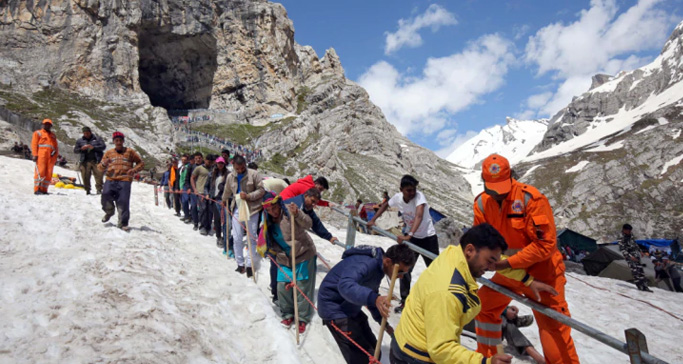
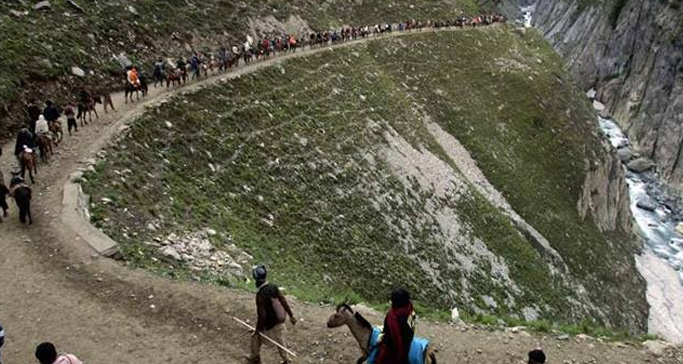
By Road : Amarnath is on a deceptive territory, henceforth it isn't all around associated by street. One can venture out to Jammu and afterward one needs to pass by street to Srinagar and afterward to reach Baltal or Pahalgam. Baltal is the most limited trek in transit up to Amarnath, however marginally troublesome. Pahalgam trek is longer and moderately more secure and increasingly appropriate for families and senior individuals. Individuals can likewise employ horses and palkies to counter the strenuous landscape. From Baltal, it is a 1-multi day trek (15 km) to reach Amarnath. In any case, the Pahalgam course is moderately more and takes around 3-5 days (36-48 km).
Amarnath Yatra 2026 — Registration Guide
Registration for Amarnath Yatra 2026 opened on April 15, 2026. The Yatra runs from July 3 to August 9, 2026 (Raksha Bandhan). Registration is free of cost and can be done online or at designated bank branches.
- Visit the official SASB portal: jksasb.nic.in or go to a designated bank branch (J&K Bank, PNB, YES Bank, Punjab & Sind Bank).
- Obtain a compulsory health certificate from a registered doctor or approved hospital confirming you are medically fit for high-altitude trekking.
- Fill the registration form online or at the bank, upload/submit the health certificate and ID proof.
- Receive your Yatra Permit (Yatra Parchi) — carry this at all times during the pilgrimage.
- Age limit: 13 to 70 years
- Pregnant women (6+ months) are not permitted to register
- Persons with serious cardiac, pulmonary or blood pressure conditions should consult their doctor before registering
- Medical certificate must be obtained from an SASB-approved hospital — a list of approved hospitals is available on jksasb.nic.in
Pahalgam vs Baltal Route — Which Should You Choose?
There are two main trekking routes to reach the Amarnath Cave. The Pahalgam route is the traditional pilgrimage path, while the Baltal route is the shorter, steeper alternative.
| Factor | 📛 Pahalgam Route | ⛨ Baltal Route |
|---|---|---|
| Distance | 36–48 km (one way) | 14–15 km (one way) |
| Duration | 3–5 days | 1–2 days |
| Difficulty | Moderate — gradual ascent | Difficult — steep & challenging |
| Best For | Families, seniors, first-timers | Fit trekkers, repeat pilgrims |
| Key Campsites | Chandan Wari → Sheshnag → Panchtarni | Baltal → Domail → Sangam → Cave |
Distances from key cities: Jammu to Pahalgam — approx. 315 km | Jammu to Baltal — approx. 290 km | Srinagar to Pahalgam — approx. 95 km | Srinagar to Baltal — approx. 95 km | Katra to Amarnath — approx. 380 km via Pahalgam.
Amarnath Helicopter Booking 2026
Helicopter services provide a convenient option for pilgrims unable to undertake the full trek. The service operates from Neelgrath (near Baltal base camp) to Panjtarni, which is approximately 6 km from the cave (reachable by pony or palanquin).
- Route: Neelgrath (Baltal) ↔ Panjtarni — approx. 10 minutes flying time
- Operators: SASB empanelled operators including Pawan Hans and other approved services
- How to book: Online via the official SASB portal at jksasb.nic.in — advance booking strongly advised as seats fill quickly
- Helicopter booking start date 2026: Check jksasb.nic.in for confirmed opening date
- Note: Helicopter service is subject to weather conditions and may be cancelled at short notice at high altitude
What to Pack for Amarnath Yatra
Amarnath Cave is at 3,888 metres altitude. Temperatures during July–August range from 5°C to 15°C during the day and can drop below 0°C at night. Sudden rainfall is common. Proper preparation is essential for a safe and comfortable pilgrimage.
- 👢 Footwear: Waterproof trekking boots with ankle support and good grip — essential for rocky, wet trails
- 🦴 Clothing: Thermal base layers, fleece mid-layer, waterproof windproof outer jacket
- ☔ Rain gear: Compact rain poncho or jacket — rains are frequent at high altitude
- 🌞 Headgear: Woollen cap, gloves, and UV-protection sunglasses
- 💉 Walking stick / trekking pole: Strongly recommended for steep terrain
- 💧 Hydration: Water bottle (1+ litre), electrolytes, dry fruits and energy bars
- 💊 Torch / headlamp: For pre-dawn starts and camp nights
- 💊 Altitude medication: Consult your doctor — carry Diamox if advised; first aid kit with basic medicines
